Leroy Neiman, a renowned American artist celebrated for his vivid, impressionistic works, has left an indelible mark on the art world through his dynamic depictions of sports, celebrities, nightlife, and modern spectacle. His paintings pulse with color, movement, and immediacy, capturing not merely what things looked like, but how they felt in moments of heightened energy. Among his most iconic and enduring creations is the Femlin—a cheeky, spirited, and often controversial figure that became one of Neiman’s most recognizable motifs. Playful yet provocative, the Femlin captured the essence of Neiman’s love for motion, humor, and the expressive human form, while also sparking discussion of sexuality, popular culture, and the shifting role of women in visual art.
The Birth of the Femlin
The Femlin series began in the early 1950s as a whimsical and irreverent exploration of pin-up culture. Introduced initially as a humorous diversion, the Femlin was an exaggerated female figure rendered in black-and-white, with sweeping lines and an unmistakable personality. Often nude or scantily clad, these figures were never meant to be anatomically realistic. Instead, they embodied Neiman’s belief that exaggeration could reveal truth more effectively than strict realism. Their elongated limbs, arched backs, and buoyant gestures gave them a sense of perpetual motion—figures caught mid-dance, mid-laugh, or mid-escape.
What distinguished the Femlin from traditional pin-up imagery was Neiman’s painterly approach. Rather than polishing the figure into a static ideal, he infused each Femlin with spontaneity and movement. The brushstrokes remained visible, the colors unapologetically intense. In Neiman’s hands, eroticism became animated rather than posed, energetic rather than fixed.
The Feminine Archetype and Cultural Duality
At their core, the Femlin reflect the cultural contradictions of mid-20th-century America. Emerging alongside the sexual revolution and second-wave feminism, they simultaneously celebrated liberation while provoking critique. Neiman’s Femlin was brash, mischievous, and exuberantly alive. Unlike the demure, passive female figures of classical art, they seemed to act rather than be acted upon. They laughed, leapt, sprawled, and reveled in their own presence.
Yet the Femlin also carried a deliberate tension. She existed in a space between empowerment and objectification, between satire and seduction. This duality—so often present in Neiman’s work—mirrored the complexities of popular culture itself. The Femlin was not meant to resolve these contradictions, but to embody them, making her one of Neiman’s most psychologically layered inventions.
Femlin and Pop Culture
The Femlin’s reach extended far beyond the studio. Through Neiman’s long association with Playboy, the character became a recurring icon of American pop culture in the 1960s and 1970s. She appeared not only in magazine illustrations but across posters, calendars, books, and merchandise. In doing so, Neiman collapsed the divide between fine art and mass media, a hallmark of Pop Art’s broader mission.
The Femlin’s accessibility was intentional. Neiman believed that art should engage the world directly rather than retreat into academic isolation. The Femlin, reproduced widely yet unmistakably authored, became a visual shorthand for Neiman’s worldview: art that was bold, humorous, sensual, and alive with contemporary energy.
Art in Motion: The Femlin as Automotive Canvas
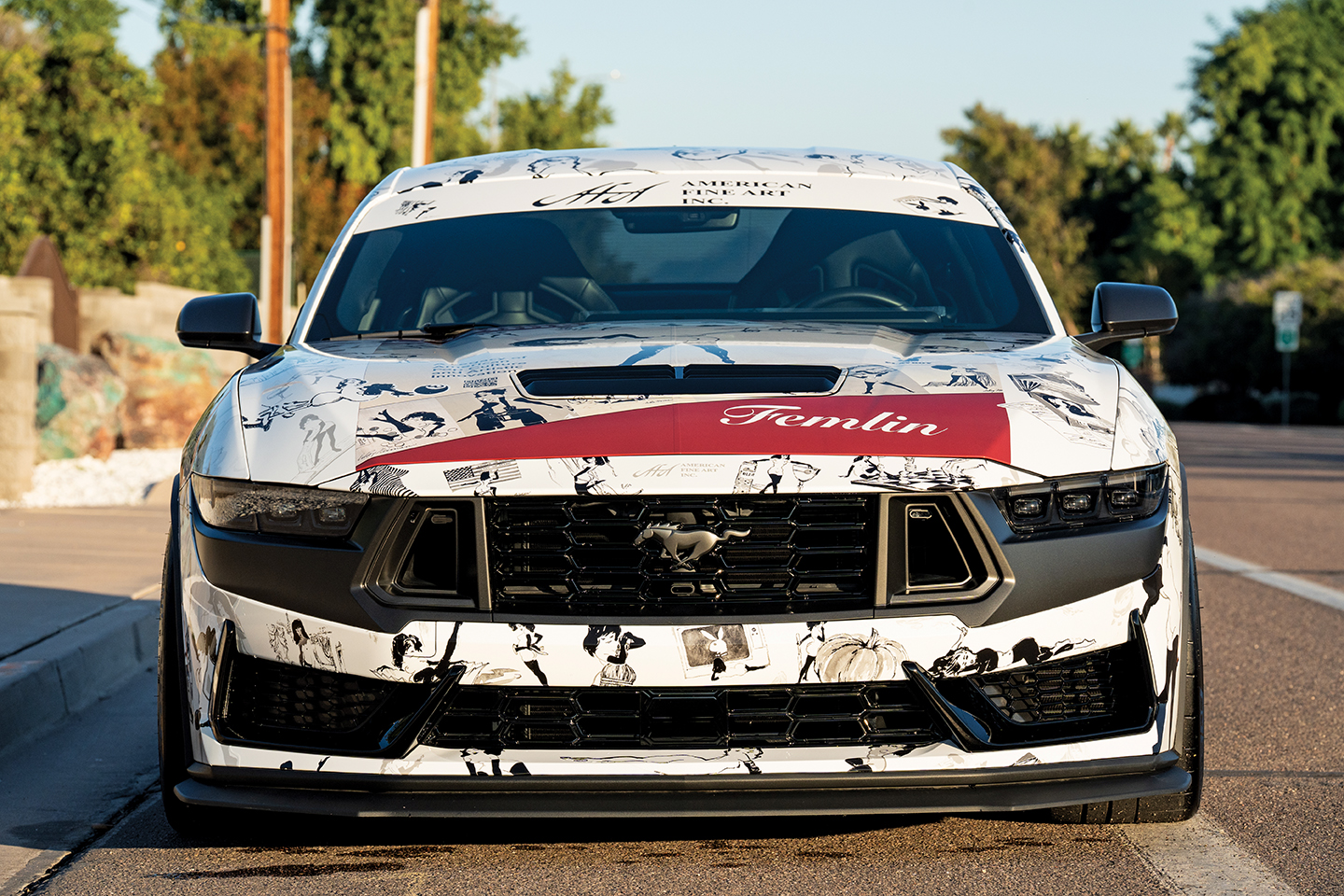
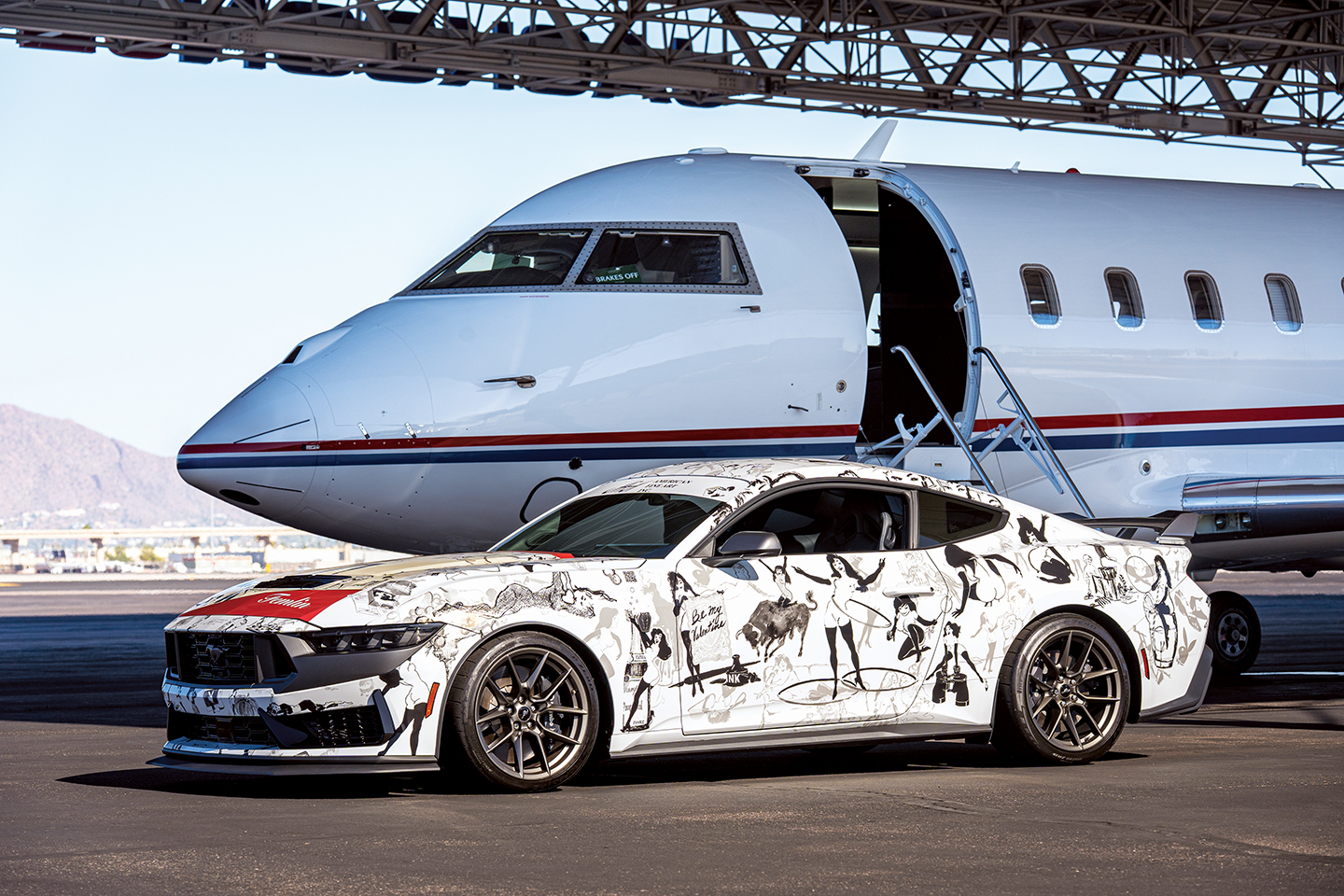
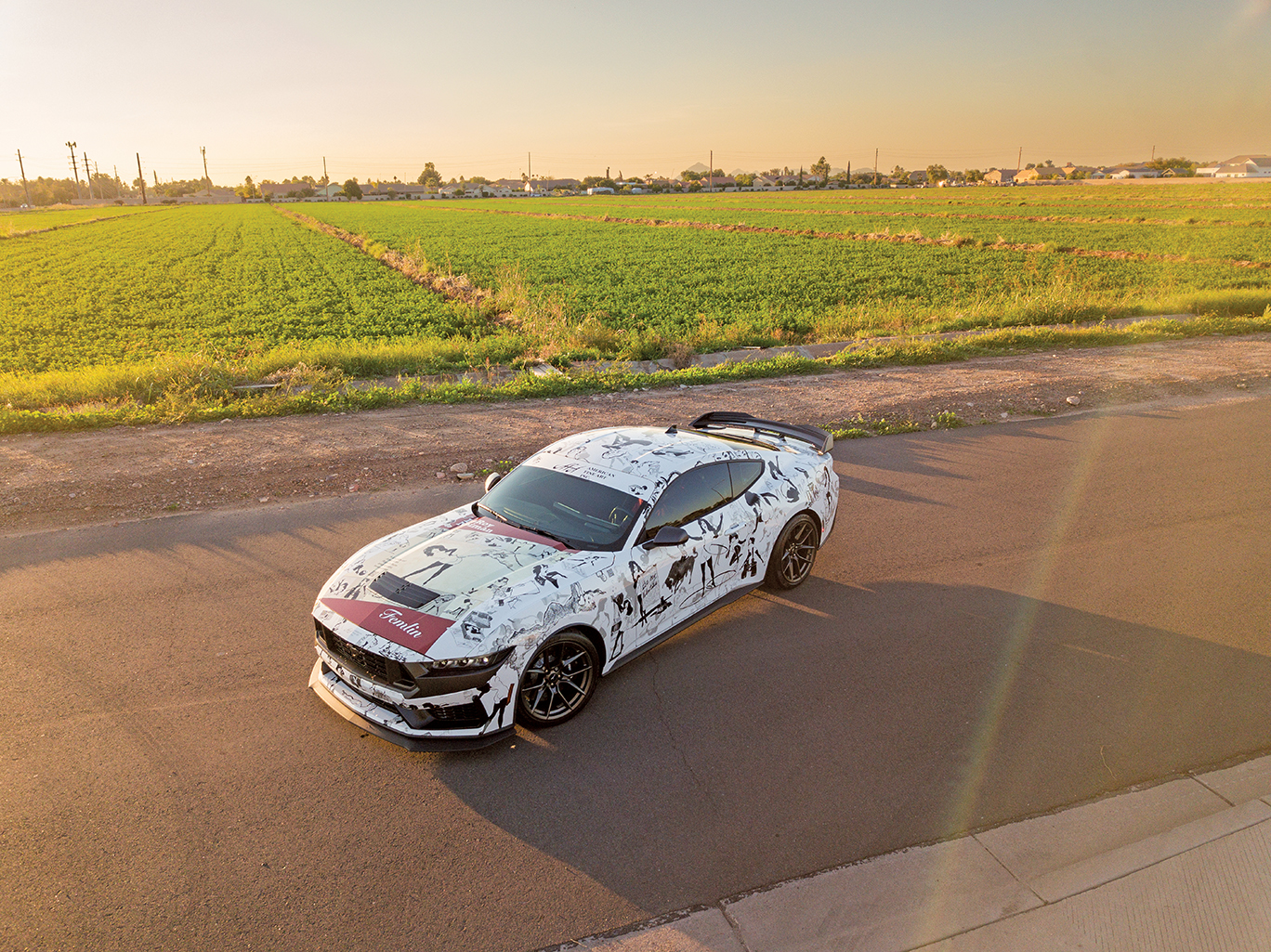
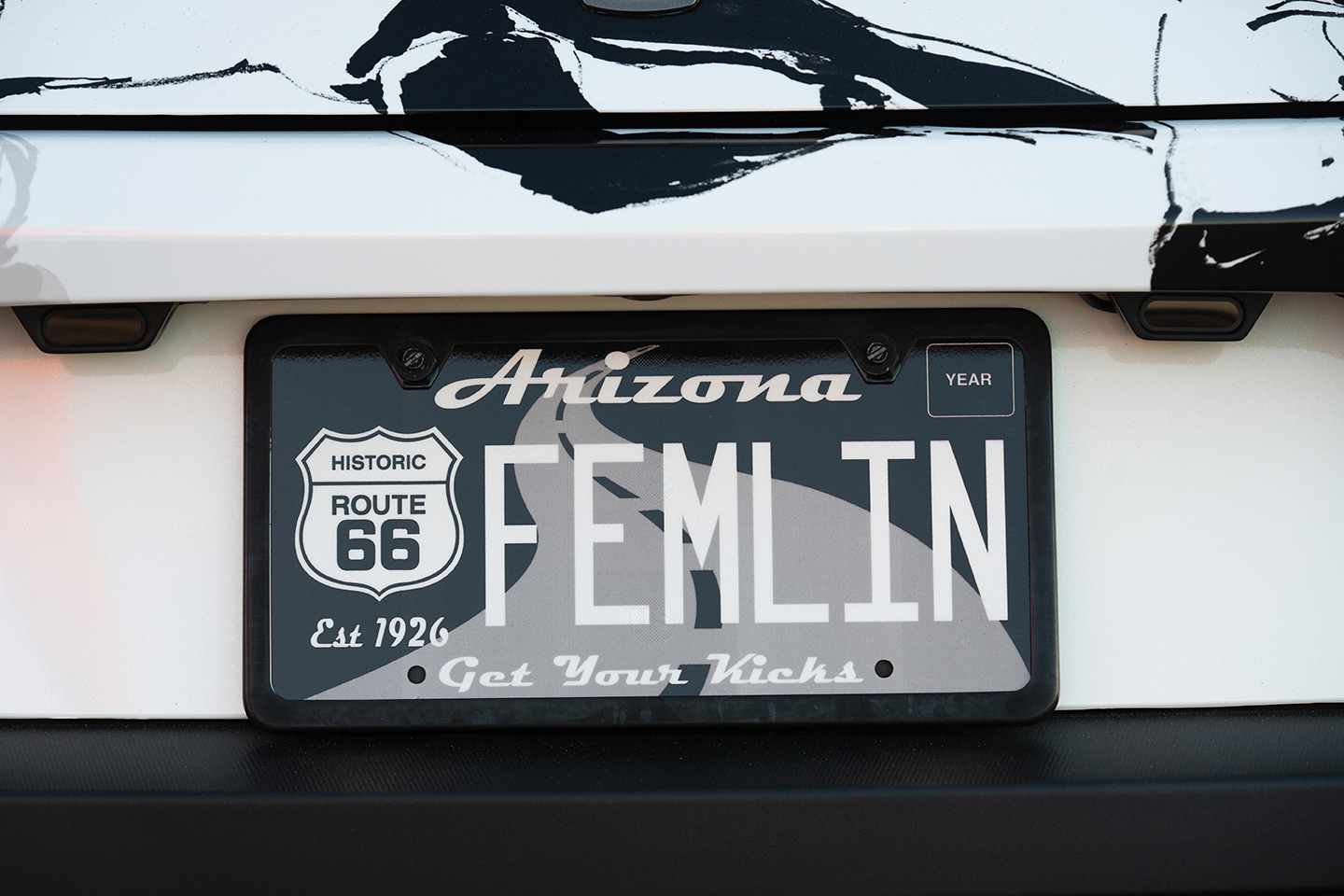
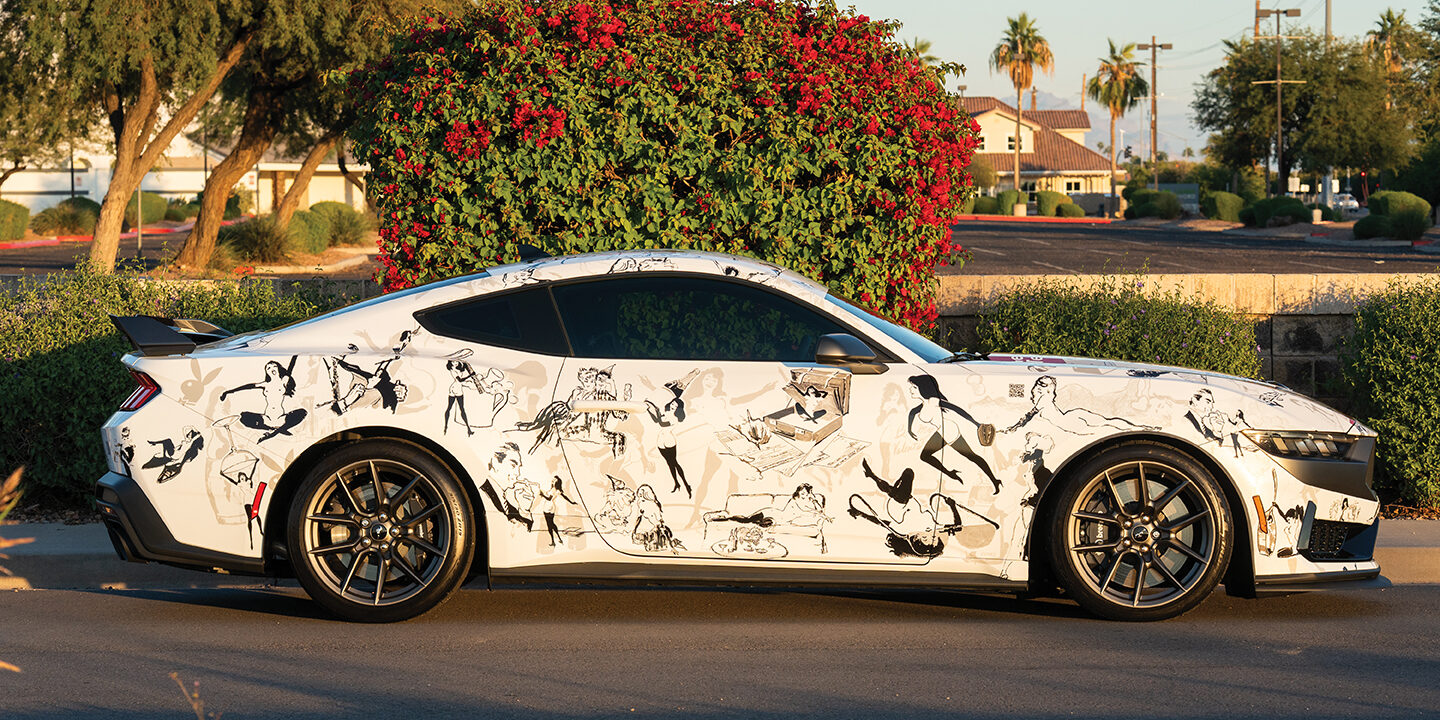
That same philosophy finds a striking modern continuation in the transformation of the Femlin into a full-scale automotive wrap on a 2025 Mustang Dark Horse. Here, Neiman’s most kinetic figure leaves the static surface of paper and canvas and enters the physical world as a moving artwork. The car becomes a contemporary extension of Neiman’s vision—Pop Art not just displayed, but experienced.
The Mustang Dark Horse is an icon of modern American engineering and design. Equipped with a factory-installed supercharger producing over 800 horsepower, it represents the pinnacle of Mustang performance—raw, aggressive, and unapologetically powerful. Its sculpted body lines, aerodynamic stance, and thunderous presence align naturally with Neiman’s visual language. Just as Neiman exaggerated form to communicate movement, the Dark Horse exaggerates power to communicate speed and dominance.
Wrapped in Femlins, the car becomes more than a vehicle. It becomes a rolling tableau of color and motion, where Neiman’s playful figures appear to race across the surface, activated by velocity. As the car moves, the Femlins seem to dance along its curves, their energy magnified by sound, speed, and light. This is not decorative art—it is experiential Pop Art.
Power, Performance, and Personality
The pairing of Femlin imagery with the Dark Horse is conceptually precise. Both celebrate excess, confidence, and spectacle. The Femlin’s exaggerated sensuality mirrors the car’s exaggerated power. The supercharged engine’s explosive force echoes the irrepressible vitality of Neiman’s figures. Together, they form a dialogue between human expression and mechanical prowess, between art and engineering.
Neiman spent much of his career painting moments of peak intensity—athletes at the height of exertion, nightlife scenes saturated with sound and color. The Mustang Dark Horse exists in that same realm of heightened experience. Loud, fast, and visually commanding, it is a modern arena where Neiman’s aesthetic feels entirely at home.
Legacy Reimagined
This Femlin-wrapped Dark Horse is not a nostalgic gesture; it is an evolution. It demonstrates how Neiman’s work continues to resonate in contemporary culture, adaptable to new mediums while retaining its core spirit. Just as Neiman once embraced print media, advertising, and commercial platforms without compromising artistic integrity, this project embraces automotive design as a legitimate extension of visual art.
The result is a modern American icon adorned with a modern American icon. The car collapses boundaries—between gallery and street, between fine art and performance, between static object and moving experience. It fulfills Neiman’s lifelong ambition to make art that lived in the world rather than observing it from a distance.
Pop Art at Full Throttle
The Femlin remains one of Leroy Neiman’s most enduring contributions to visual culture—a figure defined by movement, contradiction, and joy. On the body of a 2025 Mustang Dark Horse, she finds a new stage, one fueled by horsepower rather than paint, yet guided by the same principles of energy, freedom, and unapologetic expression.
This union of art and machine is Pop Art at full throttle. It honors Neiman’s legacy not by preserving it behind glass, but by letting it move, roar, and command attention—just as he always intended.
American Fine Art Inc.
p: 480.990.1200
e: afa@tobiasse.com
w: americanfineartgallery.com
3908 North Scottsdale Road
Scottsdale, Arizona 85251
Gallery